04 January 2026
What Does “Risk” Mean in Childhood?
In childhood, everything is a discovery. Climbing a fallen log, jumping in muddy puddles, running and riding a bike on uneven ground… these may look risky through adult eyes, but for children they are moments rich in learning, confidence, and freedom.
At Escola Lá Fora, we believe that contact with risk is essential for healthy growth and for the development of skills that children will carry with throughout their lives.
What Does “Risk” Mean in Childhood?
When we talk about risk, we are not talking about danger. Danger is a situation in which a child can be seriously hurt without being aware of it or having the means to protect themselves. Risk, on the other hand, is the possibility of challenge and of making mistakes - something that can be attempted, explored, and learned from.
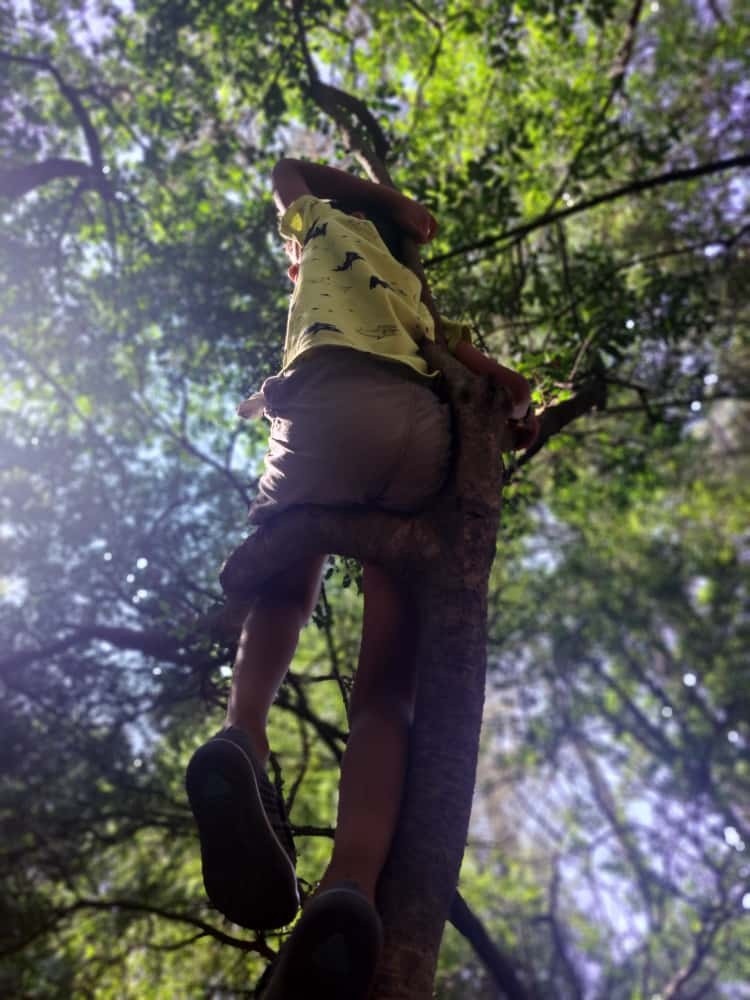
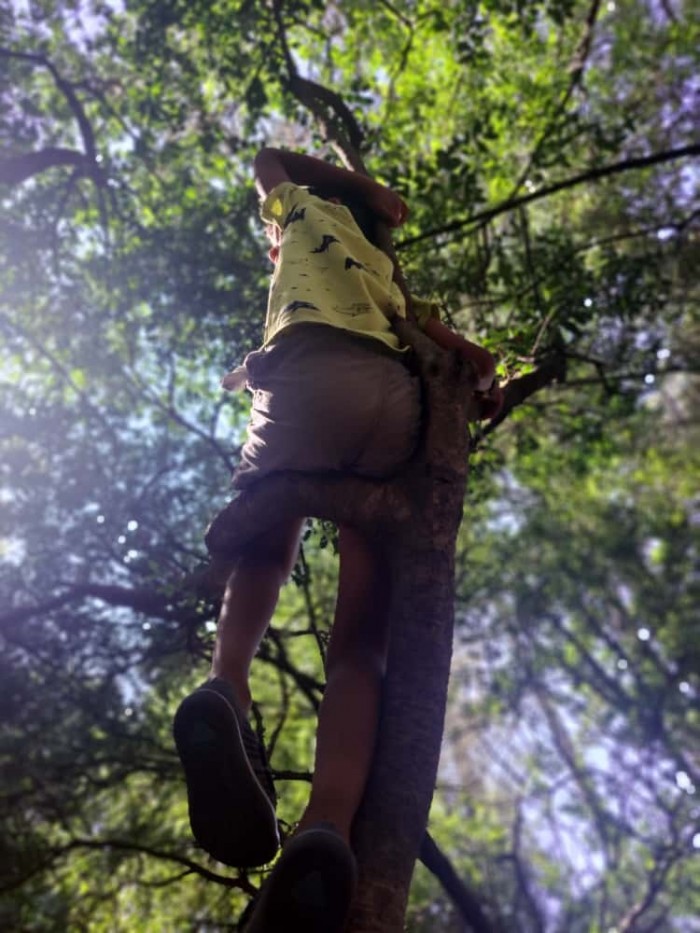
For a child, climbing a tree may be risky, but it is not dangerous if the environment is supported by safety rules, attentive adults, and the child’s confidence in their own abilities. It is in this space between the unknown and what is yet to be discovered and mastered that a child’s growth truly happens.
The Benefits of Engaging with Risk
Whenever a child takes a risk to try something new, they are building important skills:
-
Self-confidence: they realise they can do more than they imagined;
-
Problem-solving: they find strategies to overcome obstacles and achieve their goals;
-
Motor skills: by taking risks, children develop their motor skills more effectively, exploring new possibilities of movement;
-
Autonomy and responsibility: they assess what they can and cannot do and learn to make more conscious decisions;
-
Resilience: they learn to cope with frustration when something does not go as planned and to try again.
Several international studies reinforce the importance of contact with risk in childhood, and although fewer in number, studies carried out in Portugal also confirm these benefits. Some references can be found at the end of the article.
Risk at Escola Lá Fora
At Escola Lá Fora, contact with risk is an integral part of our philosophy.
Unlike a traditional classroom, where space is controlled and carefully planned, the forest changes every day: a wet log, a branch on the ground, mud after the rain. It is within this outdoor learning context that risk emerges naturally and creates rich opportunities for exploration.
Here are some examples from our daily life:
-
Children learn to use real tools, always under adult supervision and in accordance with safety rules;
-
They take part in activities such as campfires for cooking, exploring fire as a useful, transformative element that requires care and respect;
-
They climb trees, overcome obstacles, and explore the uneven forest terrain, developing greater awareness of their bodies and their surroundings.
For us, every risk is an opportunity for learning. We do not protect children from everything; instead, we help them build the inner tools they need to protect themselves.
Skills for the Future
We live in a constantly changing world, and we do not know what the future will look like. The professions that will exist in 20 years may not even have names yet. But we do know that the most important skills will remain universal: autonomy, creativity, courage, resilience, empathy, and critical thinking.
A child who has learned to balance on a slippery log, to become increasingly autonomous in using a tool, or to manage the fear of climbing higher in a tree becomes a person who is more confident and better equipped to face increasingly complex and unpredictable challenges.
Trusting Children and Nature
For many families, trusting that their children can face risks is a difficult step. But what we discover every day in the forest is simple: when we offer freedom with responsibility, children gain a deeper understanding of their abilities and their limits.
Risk is not the enemy of childhood. On the contrary, it is one of its greatest allies.
Allowing children to play in nature, to test the limits of their bodies and their imagination, is giving them a solid foundation for the future.
The forest teaches resilience, teaches calm, and teaches courage. And among the trees, we all learn - adults and children alike - that growing also means taking risks.
Pertinent research
-
1. Dabaja, Z. F. (2021). The Forest School impact on children: reviewing two decades of research. Education 3-13, 50(5), 640-653.
-
2.Sella, E., Bolognesi, M., Bergamini, E., Mason, L., & Pazzaglia, F. (2023). Psychological Benefits of Attending Forest School for Preschool Children: a Systematic Review. Educational Psychology Review, 35(1).
-
3. Prins, J. C., Wittenberg, R., Schölmerich, V. L. N., van Keulen, H. M., & van der Veer, R. (2022). Nature play in early childhood education: A systematic review. Early Child Development and Care, 192(14), 2273–2292.
-
4. Sandseter, E. B. H., & Sando, O. J. (2021). “We don’t allow children to climb trees”: How a focus on safety affects Norwegian children’s risky play in early childhood education and care. Child Indicators Research, 14(2), 861–880.
-
5. Brussoni, M., Gibbons, R., Gray, C., Ishikawa, T., Hansen Sandseter, E. B., Bienenstock, A., ... & Tremblay, M. S. (2015). What is the relationship between risky outdoor play and health in children? A systematic review. International Journal of Environmental Research and Public Health, 12(6), 6423–6454
-
6. Friães, R., Reis, J. & Rocha, C. (2024). Crescer com o risco: Comportamentos das crianças e de supervisão do adulto em situações de brincadeiras arriscadas, em contexto de Jardim de Infância. Investigar em Educação, (11), 70–89.
Sofia Rocha, Escola Lá Fora Almada’s Coordinator