23 April 2026
What boredom teaches children
“I’m bored.”
For many adults, this sentence immediately sets off an alarm. An almost automatic urge to fill the gap, suggest something, and entertain: one more activity, one more stimulus, one more response.
But… what if boredom isn’t a problem? What if it’s actually a fertile space?
The emptiness that creates
In a society where everything is fast, immediate, and full, emptiness becomes uncomfortable. But for children (and even for us adults), boredom is essential.
It’s in boredom that:
- unexpected ideas arise;
- self-initiated play is born;
- materials, space, and the body are explored;
- imagination is built.
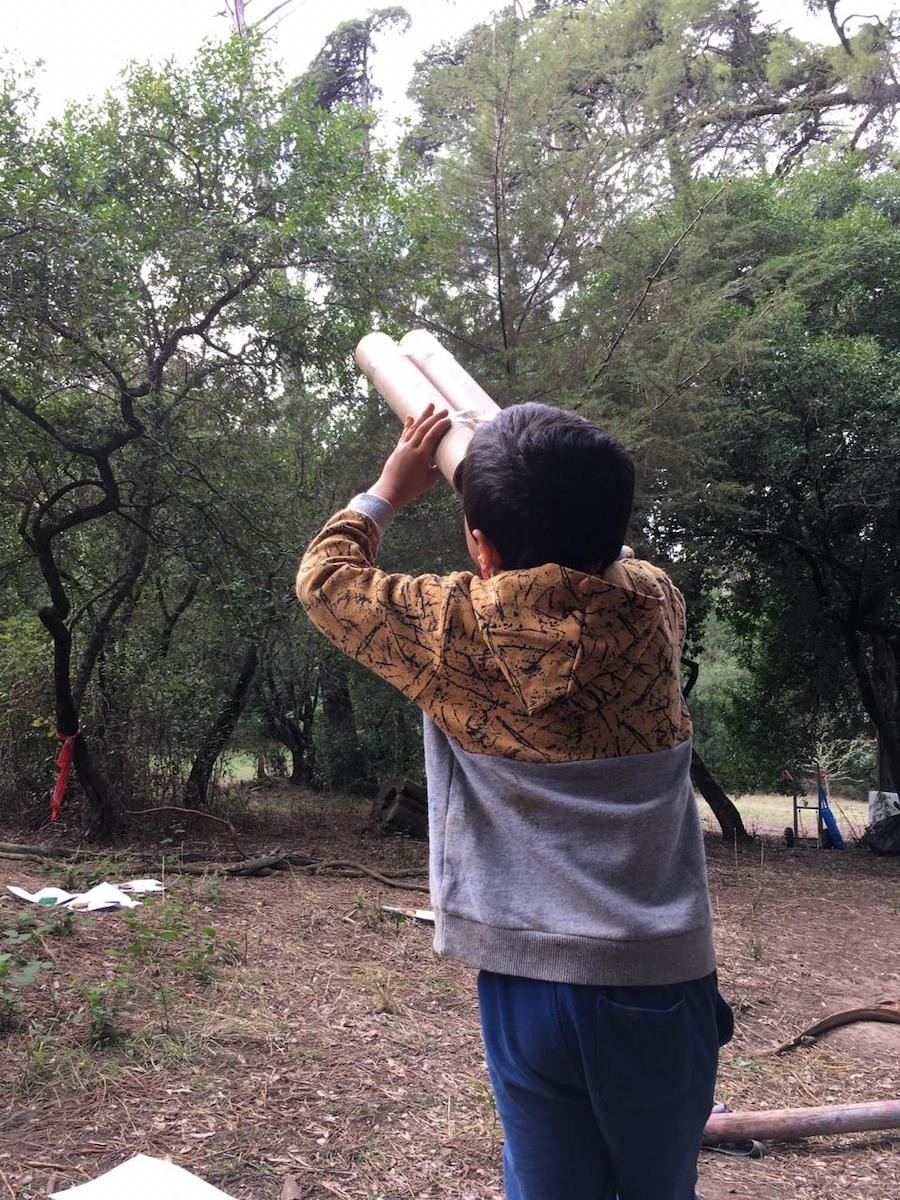
In outdoor learning contexts, such as a Forest School or a nature-based school, this “boredom” appears more naturally.
There is no constant stimulation. No entertainment prepared for every minute. There is nature. There is time. There is freedom. And that can seem… boring.
Curiously, many of the richest forms of play begin with: “There’s nothing to do…”
And then:
- a stick becomes a sword;
- leaves turn into food;
- a bush becomes a house;
- a stone starts a collection;
- a group invents a story.
This is how play in nature is born: spontaneous, meaningful, and whole.
The initial resistance
When a child says “I don’t know what to do,” they are often on the threshold of something important. But that threshold can be uncomfortable—especially for children used to highly structured routines, constantly guided activities, or packed schedules.
The adult’s impulse is to help by giving ideas and “solving” the situation. But in doing so, they may be interrupting an invisible process.
Our role as adults
Holding space for a child’s boredom is not the same as ignoring them. It means being available… without intruding. It means trusting that they are capable of finding their own path and that sometimes they just need a small nudge.
The adult’s role can be:
- being nearby, but not directing;
- observing before intervening;
- resisting the urge to entertain;
- trusting the process.
“But they’re really doing nothing…” Yes. And that may be exactly what they need.
In boredom, the child:
- organizes their thoughts;
- processes experiences;
- discovers interests;
- experiments with autonomy.
It is a less visible time, but deeply rich.
In more traditional preschool settings, this time tends to be more limited. But in contexts such as a nature-based school, it is protected—because its value in child development is recognized.
Still, you don’t have to be in a Forest School to allow this. Even at home, in the city, in apartments, with babies or young children, it is possible to create space for the potential of boredom.
Some simple ideas:
- reduce constant stimuli (fewer screens and fewer “offers” of activities);
- leave certain materials accessible, such as simple, natural, and open-ended objects;
- accept moments of “doing nothing”;
- trust that something will emerge.
And perhaps the hardest part: tolerating the initial discomfort.
In the end…
Boredom is not emptiness. It is space to imagine, create, explore, fail, and try again.
It is in that gap—between nothing and something—that many of the deepest forms of learning take place.
And perhaps the greatest challenge is not for children, but for us: to trust, to wait, and not to fill every moment.
Sofia Rocha, Coordinator Almada