07 September 2026
How do you learn at Escola Lá Fora?
“If they spend the whole day in the forest… how do they learn?”
This is one of the questions that some families visiting Escola Lá Fora sometimes ask. It’s a natural question. For many years, we’ve become accustomed to associating learning with desks, textbooks, worksheets and moments when all the children are doing exactly the same task.
“Everything you do within four walls can be done outdoors. But not everything you do outdoors can be done within four walls.”
This sentence sums up much of what we believe in. Learning in the forest does not mean giving up the learning that takes place in other contexts. It means broadening it, enriching it and giving it a real-world context. Writing, counting, drawing, investigating, creating and problem-solving are all part of our daily lives. However, this learning is linked to experience, curiosity, nature and relationships, making it more meaningful and lasting.
Learning in context = Meaningful learning
Imagine a group of children who decide to build a hut in the forest. At first glance, it might seem like just a game. But that experience is full of learning opportunities.
Whilst searching for the most suitable materials, the children compare the strength of the branches and make assumptions about which ones will be safest to use.
When they measure and count sticks and logs, estimate distances or build a structure, they are exploring mathematical concepts in a natural way.
By discussing ideas, explaining their reasoning, negotiating solutions or sharing what they have discovered, they develop language and communication skills.
And, perhaps more importantly than all of this, they learn to cooperate, to listen to different perspectives, to cope with frustration, to make decisions together and to take on responsibilities.
None of this learning takes place in isolation. Just as in life, different areas of knowledge constantly intersect.
Are there educational objectives?
At Escola Lá Fora, we follow the Curriculum Guidelines for Pre-school Education, just as any pre-school institution would. We strive, however, to ensure that learning is meaningful and purposeful, integrated into everyday experiences.
More meaningful than counting items on a worksheet is counting how many friends are in the group on a particular day to see how many paintbrushes we need for the activity.
More meaningful than copying letters is writing a message to leave for friends after a discovery in the woods.
When learning responds to a genuine need and interest, it becomes more meaningful and lasting.
Play is not a break from learning
There is still a perception that play and learning are not interconnected. However, we know – because research tells us so – that play is one of the most comprehensive forms of learning during childhood.
Whilst playing, children experiment, ask questions, test hypotheses, devise strategies, develop language skills, learn to interact with others and build knowledge about the world, giving it meaning.
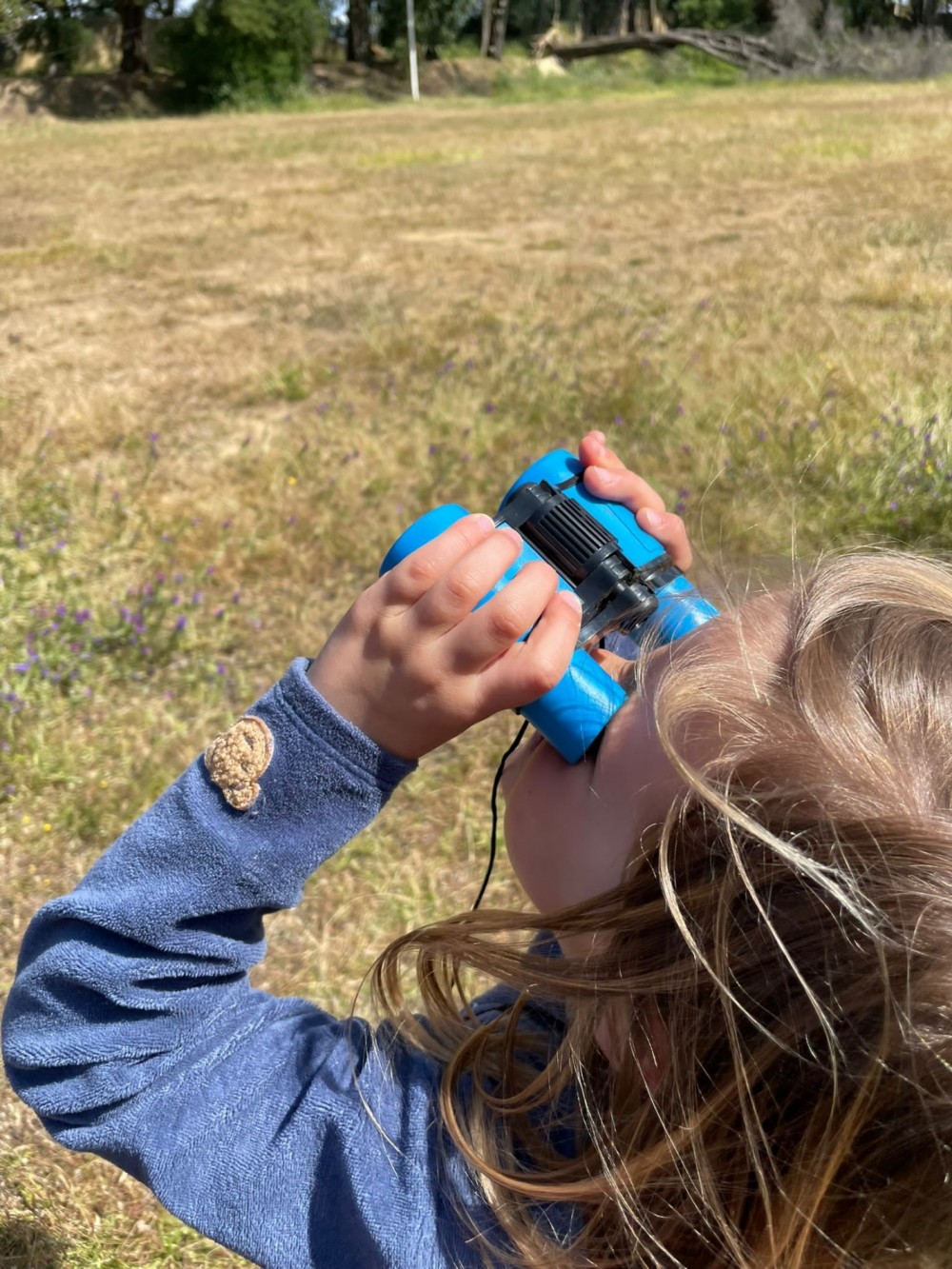
In an outdoor learning approach, the environment presents challenges that cannot be fully anticipated by an adult, as is the case in a classroom, for example. A fallen tree trunk can become a bridge. A puddle of water becomes an opportunity to investigate its depth or the reflections in it. A nest found on the ground sparks conversations about the cycle of life and respect for nature.
It is these experiences that bring learning to life!
And what is the role of the educator?
The role of the educator in a Forest School requires a great deal of intentionality.
It is the adult who prepares the learning environment, observes each child closely, listens to their questions, documents their interests and identifies opportunities to deepen their learning.
Sometimes, a single question or a comment made at just the right moment is enough to pave the way for an investigation that may last for days or weeks.
At other times, it is necessary to introduce new materials, set a challenge or simply allow time for the children to discover their own curiosities and answers.
How we approach different subject areas
At Escola Lá Fora, we do not divide the day into ‘maths time’, ‘language time’ or ‘science time’.
Life doesn’t work like that. Neither does learning.
The projects we develop often stem from the children’s curiosity or their needs, and allow us to integrate different areas of knowledge in a natural way.
A project on birds might involve scientific observation, drawing, building bird feeders, counting the species observed, reading and exploring books, writing records of discoveries, and discussions about migration, amongst many other possibilities.
It is precisely this link between experience and knowledge that makes learning in the forest so enriching.
More than just preparing for school, preparing for life
Knowledge is important. But so too are independence, creativity, resilience, problem-solving skills, communication, empathy and self-confidence.
All these skills will be essential throughout life and are developed when children have time to play, explore, experiment, make mistakes, try again and discover things for themselves and with one another.
The benefits of the Forest School approach go beyond simply being in contact with nature. They extend to the development of critical thinking, the ability to cooperate, resilience and curiosity – qualities that stay with each child well beyond childhood.
The aim is not merely for children to know how to answer a question correctly. It is for them to understand the world, to feel a desire to continue learning and discovering, and to realise that they are capable of tackling new challenges with confidence.
Sofia Rocha
Kindergarten Teacher and Coordinator at Escola Lá Fora Almada