17 Setembro 2025
Loose Parts Play: Freedom, Creativity, and Connection in Nature Play
“When children play with loose materials, they enter a world of probabilities and uncertainties that develops critical thinking, problem-solving, and reasoning.”
— Madalena Cancela, Master’s dissertation, 2021
At a time when free play is increasingly replaced by structured activities and toys with predefined functions, the pedagogical approach of loose parts play emerges as a breath of fresh air. This concept, developed in the 1970s by Simon Nicholson, is based on the idea that “everyone is creative” when they have access to variable elements — sticks, stones, ropes, fabrics, reused objects - that can be interacted with in open, free, and unscripted ways.
Early Childhood Educator Madalena Cancela explored this theme in depth during her Master’s internship in Pre-School Education at an institution that values outdoor spaces. Her research sought to understand how loose parts influence children’s play, their social interactions, and the educator's role within this dynamic.
What Are “Loose Parts”?
“Loose parts are materials that children can carry, combine, reorganise, assemble, separate, and assign multiple meanings to in almost infinite ways.”
— Daly & Beloglovsky (2015), cited in Cancela, 2021
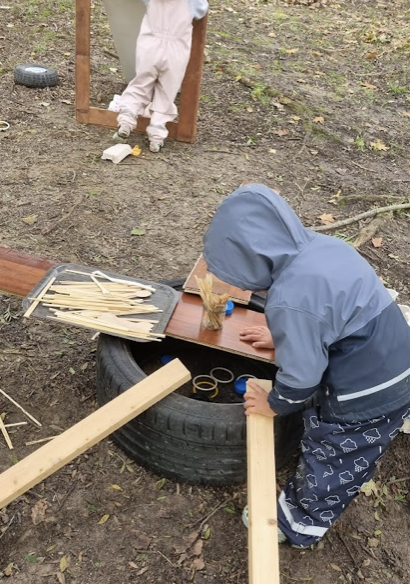
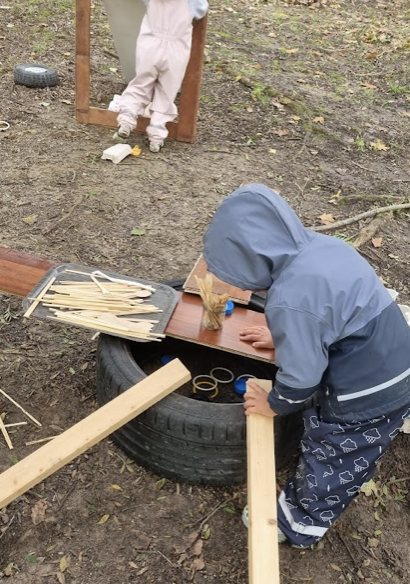
They are natural or reusable elements (such as shells, cardboard tubes, boxes, stones, fabrics, utensils, planks, or tyres) that do not have a fixed purpose. They are the opposite of closed, pre-programmed toys. Precisely for this reason, they stimulate imagination, promote creative freedom, and allow each child to explore the world in their own way.
Why Bring Loose Parts into Early Childhood Education?
“Exploring loose parts promotes a wide variety of types of play and encourages cooperative group interactions.”
— Madalena Cancela, Master’s dissertation, 2021
Throughout her research, Madalena observed a clear increase in play diversity. Children engaged in symbolic, social, dramatic, risky, and construction-based play, and much more. The simple presence of loose materials transformed the outdoor space into a true laboratory of creativity and cooperation.
In addition, there was a noticeable growth in positive social interactions: children cooperated to transport objects, shared ideas to build structures, negotiated rules, and resolved conflicts. They were more engaged, more active, and more autonomous.
And the Role of the Early Childhood Educator? Mediating Without Controlling
“It is essential to observe play, explore interests, plan the space, select and introduce materials, and give children autonomy to organise and care for them.”
— Madalena Cancela, Master’s dissertation, 2021
In this model, the adult takes on the role of an attentive observer and a sensitive mediator. The educator prepares the environment, listens to the children, and trusts in their abilities. It is not about giving instructions, but about creating the right conditions for play to flourish. This includes time, space, freedom, and rich, challenging materials.
Playing in Nature: Where Everything Connects
“Outdoor space is a privileged educational context that provides sensory, motor, emotional, and cognitive experiences essential to children’s development.”
— Lopes da Silva et al., 2016, cited in Cancela, 2021
The outdoor environment is a living classroom where body and mind meet, where children gain autonomy, courage, and a connection to the natural world. Loose parts play in this setting takes on an even richer dimension: a stone can become a plate, a plank can turn into a bridge, and a tree is always an invitation to adventure.
For Reflection and Inspiration…
“To play is to create bonds. With others, with materials, with nature, and with oneself.”
— Neto, 2020, cited in Cancela, 2021
Loose parts play is an educational approach grounded in theory, ethics, and intention. It values listening to children, freedom in play, and contact with the real world. Bringing this practice into educational settings is an act of trust: in the child, in the process, and in the power of play.
For access to the dissertation:
http://hdl.handle.net/10400.12/8456
Madalena Cancela, Diretora Pedagógica